
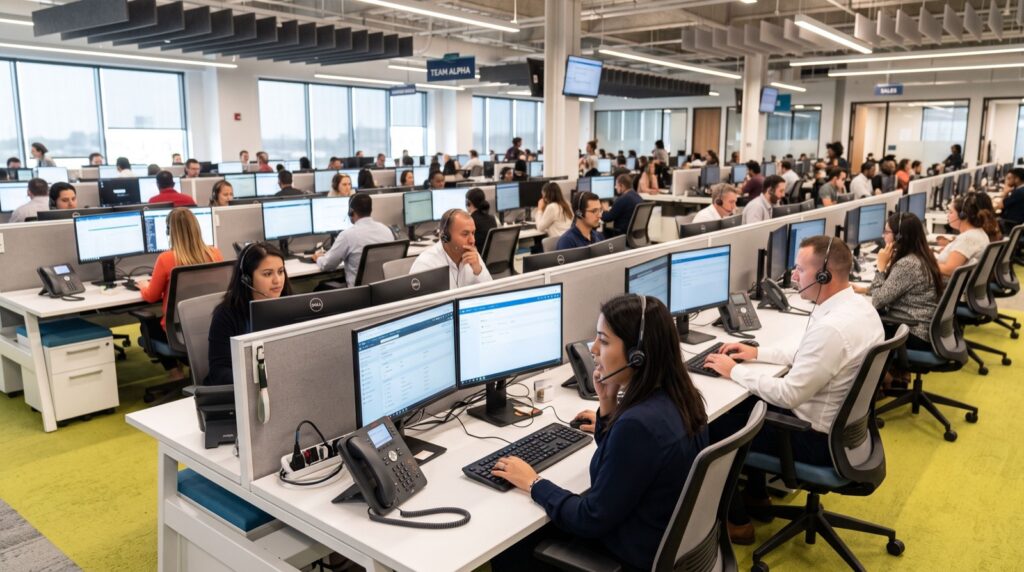
Walk into almost any busy office in Pakistan and you will still find a phone sitting on the corner of the desk. Email, WhatsApp and video calls have their place, but when a customer wants an answer right now, or a supplier needs to confirm a shipment, people reach for the handset. The strange part is how little thought most businesses put into that piece of hardware, even though it handles some of their most important conversations.
The move away from old copper lines toward internet-based calling has changed what a desk phone can be. It is no longer just a receiver and a keypad. Today it is a small networked device that plugs into the same infrastructure as your computers, and the quality of the one you pick has a real effect on how smoothly your team communicates. This guide looks at why the humble office phone deserves a second look and how to choose one that fits a growing company.
Why the desk phone refuses to disappear
Predictions about the death of the office phone have been circulating for years, yet the handset keeps earning its spot. There is something reassuring about a dedicated device that does one job well. It does not buzz with notifications, it does not need a headset paired over Bluetooth, and it does not drop a call because someone opened too many browser tabs. For reception desks, accounts departments and sales floors, that reliability is worth a great deal.
A good deal of business in this country is still relationship-driven and voice-led. Clients expect to hear a human voice, and staff expect a line that simply works when they lift it. A dedicated phone gives you that certainty in a way that a softphone running on a shared laptop rarely can.
What internet calling actually changes
When people talk about upgrading their lines, they usually mean switching to voice over the internet. Instead of a separate telephone cable running to each desk, calls travel over your existing network. That single change unlocks a surprising amount of flexibility. You can add a new extension without calling out a technician to pull fresh wiring, move a person to another desk in minutes, and route calls between branches as if everyone sat in the same room.
The hardware that sits on the desk in this setup is what most people mean when they shop for an IP Phone. It looks familiar, but underneath it speaks the language of your data network, which is why installation and day-to-day management become so much easier than with the systems many older offices are still nursing along.
Signs your office has outgrown analog lines
How do you know it is time to change? A few patterns tend to show up. You find yourself paying separately for phone service and internet when they could share one connection. Adding a new staff member means a frustrating wait for a line to be provisioned. Call quality is inconsistent, and there is no easy way to see who called, who missed the call, or how long people spend on the phone.
Another giveaway is the tangle of physical limitations. If your current system cannot handle more than a fixed number of lines, or if setting up something as basic as an after-hours greeting requires an engineer visit, you are spending money to stay stuck. Modern equipment removes those ceilings.
Compact hardware for tight desks
Not every workstation has room for a bulky phone with a big display and a forest of buttons. Reception counters, retail till points, hostel front desks and shared hot-desks often need something small that still sounds professional. This is where a slim, purpose-built handset earns its keep, giving you clear audio and the essential features without eating up the whole desk.
A model such as the Fanvil H2U is a good example of this thinking. It is designed to be affordable and space-saving while still delivering the core calling experience businesses rely on, which makes it a sensible fit for places where you need many phones but little clutter. Choosing right-sized hardware for each type of desk keeps costs sensible and keeps workspaces tidy.
The little things that decide sound quality
Buyers often fixate on price and forget that the whole point of a phone is to be heard clearly. Poor audio makes staff repeat themselves, frustrates callers, and quietly damages your reputation. Look for wideband, or HD, voice support, a handset and speaker that handle a noisy open-plan floor, and echo cancellation that keeps conversations natural.
Ambient noise is a real issue in Pakistani offices, where generators, air conditioning and street sounds all compete. Equipment with proper noise handling means the person on the other end hears your team, not the traffic outside. It is an unglamorous feature that customers notice every single day.
Planning a rollout without downtime
The fear that stops many businesses from upgrading is disruption. Nobody wants the phones to go dead during working hours. The good news is that a phased switch is entirely possible. You can run the new system alongside the old one, port numbers in a controlled way, and train staff on a handful of devices before the wider rollout.
This is where getting help pays for itself. Bringing in an experienced local team to handle the network configuration, extension mapping and testing means the changeover happens quietly in the background. A smooth cutover is worth planning for, because a botched one is exactly the story people remember.
Budgeting for the long run
Sticker price is only part of the story. When you weigh up a phone system, think in terms of total cost over three to five years. Cheaper monthly line rental, easier moves and adds, and hardware that does not need replacing every eighteen months all add up. A slightly higher upfront spend on solid devices often works out cheaper than a bargain that fails under daily use.
Key Takeaways
- Desk phones still handle a business’s most important conversations, so the hardware choice matters more than most owners assume.
- Internet-based calling removes wiring headaches, makes moves and additions painless, and lets branches connect seamlessly.
- Match the device to the desk; compact handsets suit reception counters and shared workstations where space is tight.
- Prioritise HD voice and noise handling, because clear audio is what callers actually judge you on.
- Plan a phased rollout with expert help to avoid downtime, and budget on total cost over several years, not sticker price alone.
Bringing it together
Upgrading the phones is rarely the most exciting item on a manager’s to-do list, yet few investments touch the customer experience so directly. The right handset on every desk means calls that connect, conversations that are heard clearly, and a communication setup that grows with the business instead of holding it back. Take the time to size each device to its role, insist on genuine audio quality, and lean on people who have done the migration before. Do that, and the phone on the corner of the desk stops being an afterthought and starts quietly pulling its weight.